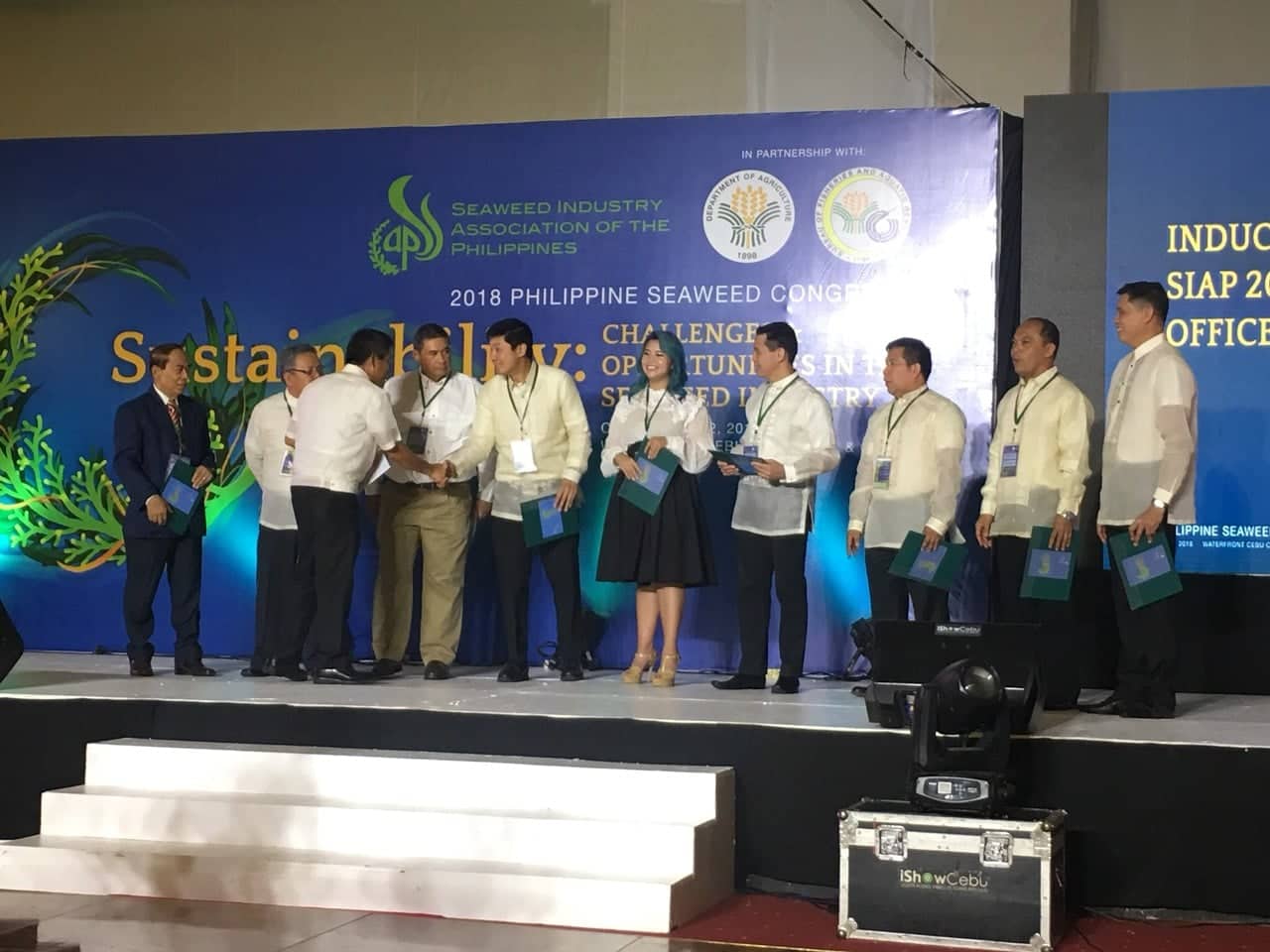
 |
| John Wee during SIAP’s induction of officers |
Monday, January 14, 2019
SIAP’S NEW VP FOR EXTERNAL AFFAIRS

Hans Porse's visit in WHI Headoffice
 |
| Hans Porse with the Sales and Marketing Team |
Sunday, October 21, 2018
WHI ACQUIRES HALAL CERTIFICATION

Last
August 4, 2018, W Hydrocolloids, Inc., a carrageenan producer and a seaweed supplier in the Philippines , was audited and achieved
certification from HDIP (Halal Development Institute of the Philippines),
a religious non-government organization which is recognized by JAKIM (Jabatan Kemajuan
Islam Malaysia), MUIS (Majlis Ugama Islam Singapura), mutual recognition with
CICOT (Central Islamic Committee Of Thailand), affiliated with IFANCA (Islamic
Food And Nutrition Council Of America), affiliated with MUI (Majelis Ulama
Indonesia) and a member of WHFC (World Halal Food Council). This means
increased marketability and scalability in the export market especially in
South East Asia where most clients request for Halal certification recognized
by JAKIM-MUI, and is also aligned with the company's commitment in meeting
customer requirements and bringing customer satisfaction to a new level of
excellence.
WHI GOES GOOGLE

In the workplace, we need a tool that can
provide us productivity, efficiency and convenience for our daily tasks, and
Google speaks to our needs. Last July
6, 2018, a Training Expert Justine Concepcion, effectively conducted the G Suite
Workshop to the WHI department heads and representatives.
Wednesday, July 18, 2018
WHI Mandaue's 2nd Quarter River Cleanup

WHI-Mandaue, had its 2nd Quarter River Cleanup in its adopted water body, the Butuanon River last June 16, 2018. The activity took place in Butuanon Bridge, Station 2 and was participated by 12 representatives from different sections with one mission: To save water bodies from pollution.


WHI'S CERTIFICATIONS UPDATES
 |
| CCC Plant Team |
CCC ACQUIRES HACCP CERTIFICATION
Cebu Carrageenan Corporation (CCC) located at Carmen, Cebu is WHI’s affiliate company that produces semi-refined carrageenan chips and powder for the export market. It has successfully passed the Hazard Analysis Critical Control Point (HACCP) Certification last March 26-27, 2018. HACCP is an international standard defining the requirements for effective control of food safety. This shows the organization’s commitment to delivering safe quality food products to our customer.
FSSC 22000 RE-CERTIFICATION OF WHI
WHI, a carrageenan producer and a seaweed supplier in the Philippines, successfully completed the FSSC 22000 recertification and transition to ver. 4.1 last April 23-24, 2018, and attended by key employees with the full support of the management. FSSC 22000 ver. 4.1 was published in July 2017 and includes an update to GFSI benchmarking requirements document ver. 7.1 and requires certified sites to be audited against the new version starting January 1, 2018. This also brought new requirements for food fraud, food defense, allergen management, environmental monitoring, management of services, use of the logo, product labeling, and mandatory unannounced audit in order to increase transparency and objectivity in the benchmarking process.
Subscribe to:
Posts (Atom)